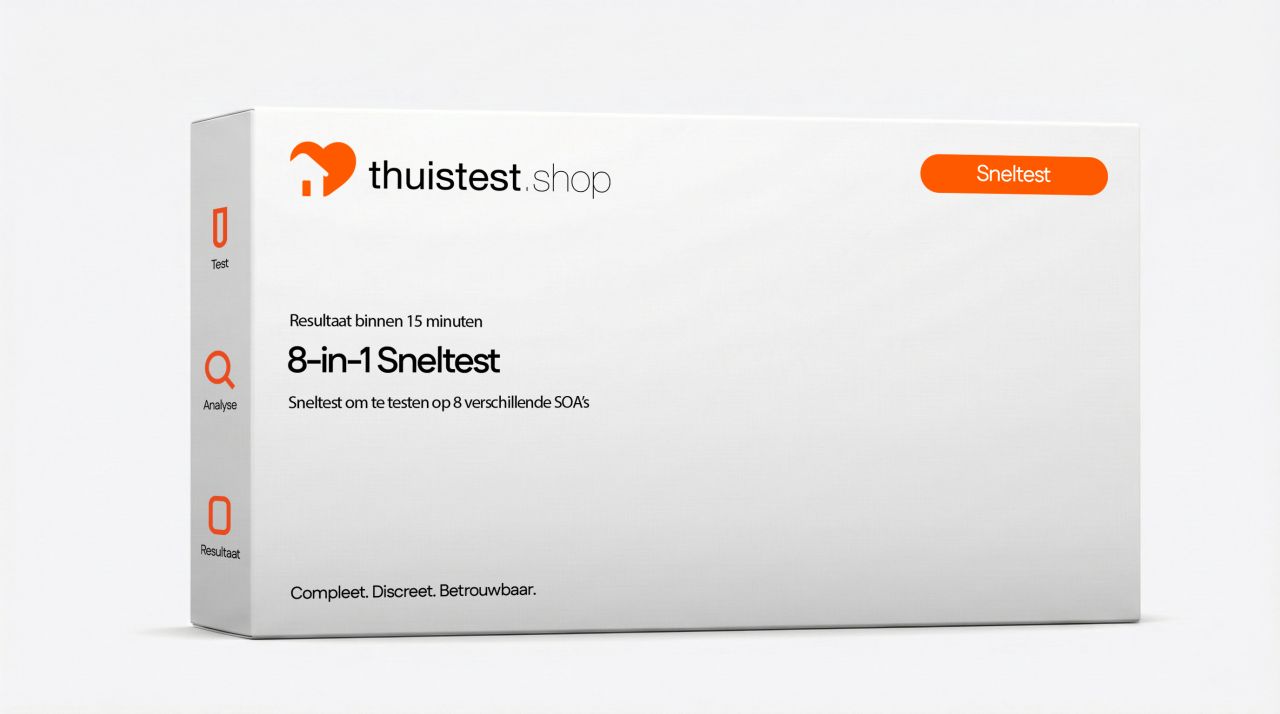
8 in 1 STD Self-Test
€ 66,07
PROFESSIONAL
In stock: 106 available
1
8 in 1 STD Self-Test
Product Details
TEST IS ONLY FOR PROFESSIONAL USE - Available mid-August 2026
The 8 in 1 STD Self-Test is designed for individuals who want a quick and discreet comprehensive check after unsafe contact, in case of doubt, or when experiencing symptoms that could indicate an STD. Instead of a single test, you get a convenient first screening for multiple common infections in one kit. This is ideal for those who don't want to miss any risks or simply want peace of mind.
Why choose this self-test?
This self-test fits well into busy schedules and situations where privacy is important. You can test at a time that suits you, without unnecessary delays. This allows you to decide quickly what makes sense: continue with peace of mind, retest at the right time, or immediately proceed with treatment and informing your partner.
What is an STD?
An STD is a sexually transmitted infection caused by bacteria, viruses, or parasites. Many STDs cause few or no symptoms, making testing often the smartest way to gain certainty. If symptoms do occur, they often include irritation, discharge, pain during urination, or pain during sex. In some cases, there are no visible signs, but transmission is still possible.
It’s important to note that an STD does not "belong to a certain type of person." It can happen to anyone. One unprotected contact is enough. Even within a committed relationship, an STD can surface because some infections can remain dormant for a long time.
About the 8 in 1 STD Home Test
The 8 in 1 STD Self-Test is a practical test kit that allows you to collect samples at home and have them assessed according to the provided instructions. Depending on the kit, this may involve a urine sample, swab sample, or even a finger prick. The test is designed to make the process as simple as possible, with clear steps and straightforward results.
The goal is not to scare you but to provide guidance. A comprehensive test is particularly useful if you’re unsure about which STD to test for or if you want to cover multiple risks in one go. This approach gives you a quicker overview compared to choosing individual tests.
General Note
A broad STD test is a helpful tool, but it is not a substitute for medical care. In cases of severe pain, fever, rapidly worsening sores, bleeding, or significant swelling, consulting a doctor is advisable. This also applies during pregnancy or with a weakened immune system.
Timing is crucial. Testing too early can miss an infection. When in doubt, retesting after the appropriate waiting period is often the best choice. Always follow the instructions provided with the test kit, especially regarding sample collection, reading time, and the optimal testing moment.
Frequently Asked Questions About the 8 in 1 STD Self-Test
When is the best time to test after unsafe contact?
This depends on what you want to rule out. For chlamydia and gonorrhea, waiting two weeks is often advisable. For trichomonas, one week is a common guideline. For Mycoplasma genitalium, two to four weeks are typically recommended. Candida and Gardnerella are usually tested when symptoms occur. Testing too early can result in a negative result while an infection is present, causing uncertainty. It helps to note the contact date and test consciously afterward. If doubt persists, retesting later can provide additional reassurance.
Is the 8 in 1 test suitable for both men and women?
Yes, this home STD test is designed for both. The sample is collected via urine, making it accessible for those who find swabs challenging. Couples can also use this test to gain clarity together. However, if someone has severe symptoms, testing alone at home is not enough. Medical help is better in such cases. For concerns about syphilis or herpes, a different test is required, usually involving blood. See this test as a broad initial check for eight components, particularly useful for doubt and urine-related symptoms.
What should someone do with a positive result?
A positive result usually means contacting a doctor or STD clinic. Many causes require medication treatment, such as chlamydia, gonorrhea, and trichomonas. Mycoplasma genitalium sometimes needs extra attention, making guidance important. Informing a partner, if relevant, prevents reinfection. Avoid sex until you’ve received advice. If pregnant or planning for pregnancy, quicker action is advisable. A positive result can be alarming, but it primarily provides direction, allowing for targeted and faster resolution.
Can someone have symptoms but still test negative?
Yes, this is possible. Timing can play a role—if you test too soon after contact, the test might not detect anything yet. Symptoms might also have other causes, such as a urinary tract infection, skin irritation, allergy, or an STD not covered by this kit. Stress and excessive washing with soap can also cause symptoms. If symptoms persist, visiting a doctor is wise. A negative result is often reassuring, but your symptoms and situation remain important for the next step.
Does this 8 in 1 self-test also test for syphilis and herpes?
No, this test focuses on eight other components. Syphilis and herpes are typically tested with a blood test, which requires a different kit. If you’ve had a clear risk contact, it might be wise to test more broadly, especially for infections not detected in urine. You can start with this comprehensive STD package for urine-related causes and expand with a blood test if necessary. This step-by-step approach builds true peace of mind without guessing.
What does the 8 in 1 STD Self-Test specifically test for?
This test is intended as a broad screening for eight common STDs and related infections. The exact list may vary per test kit, so the packaging and instructions are key. Many 8-in-1 packages focus on a combination of frequently occurring infections that often cause few symptoms.
To give you an idea, infections like chlamydia and gonorrhea are often included, along with additional causes of irritation or discharge. Consider these as examples, not a definitive list. The correct interpretation is: one test that checks multiple possible causes simultaneously, reducing guesswork.
If you want to exclude one specific STD or already suspect something, a targeted test may sometimes be more logical. But when in doubt or after a risk contact, broad testing is often practical.
Why an 8-in-1 STD test is useful
A broad test is especially effective in situations where you’re unsure what to focus on. Many people have no clear symptoms or vague complaints pointing to multiple possibilities. The 8-in-1 approach prevents testing for just one infection while missing others.
It’s also often more efficient. You don’t need to choose separate products, schedule individual tests, and it keeps things straightforward. This provides peace of mind, especially for those with limited time, who want quick results, or value privacy.
Couples may find it helpful too. After a one-night stand, a broad check can help create a plan together, based on facts rather than panic.
Symptoms: What someone may or may not notice
Many STDs cause no symptoms, which is why testing is so important. If symptoms occur, they may include:
- Burning sensation during urination
- Discharge different from normal
- Itching, irritation, or redness around the genitals
- Pain during sex
- Spotting or bleeding after sex
- Spots, sores, or bumps
These symptoms can also be caused by other issues, such as fungal infections, bacterial vaginosis, soap irritation, or a urinary tract infection. Treating based on symptoms alone is often not a good idea. Testing provides direction and prevents prolonged discomfort.
When testing is wise and when it’s not
Testing is wise after a risk contact, when new symptoms arise, or if you simply want certainty. However, it’s important not to test too early. Some STDs are only detectable after a certain waiting period. Testing too soon can result in a reassuring outcome while the body hasn’t yet clearly shown the infection.
Testing is also less useful if you’ve already been treated with antibiotics or other medications that can affect infections. In such cases, consulting a doctor or choosing the right test timing is better.
For persistent or severe symptoms, testing alone is not enough—medical evaluation is necessary.
Preparing for reliable results
Reliable results start with calm and proper preparation. Read the instructions thoroughly before starting. Lay everything out and use a timer if needed. Avoid testing during menstruation if advised in the manual. Don’t use vaginal creams, rinses, or aggressive cleaning right before sample collection as this can interfere with the process.
If you need to collect urine, it’s often important not to urinate immediately beforehand. If using a swab, take your time to collect the sample carefully. While it may seem simple, accuracy makes the difference.
Step-by-step process overview
Most people prefer a straightforward process, so keeping it simple is helpful:
- Collect the appropriate sample as per the instructions.
- Process the sample as directed.
- Complete the test and follow the reading or sending instructions.
- Note the result and decide on the next step.
Follow the reading time or instructions precisely. Acting too early or late can lead to uncertainty.
Results: Positive, negative, or invalid—what to do next
- Positive: Indicates one or more infections detected by the test. The next logical step is treatment and, if needed, confirmation by a doctor. Don’t delay, especially if symptoms are present. Inform partners to prevent reinfection.
- Negative: Suggests the tested infections are less likely at this time. However, timing is crucial. If the contact was recent, retesting after the appropriate waiting period may be wise. Persistent symptoms could indicate another cause, such as candida, bacterial vaginosis, irritation, or a urinary tract infection.
- Invalid: Means the test didn’t work properly due to sample collection, timing, or missing a step
Display prices in:EUR