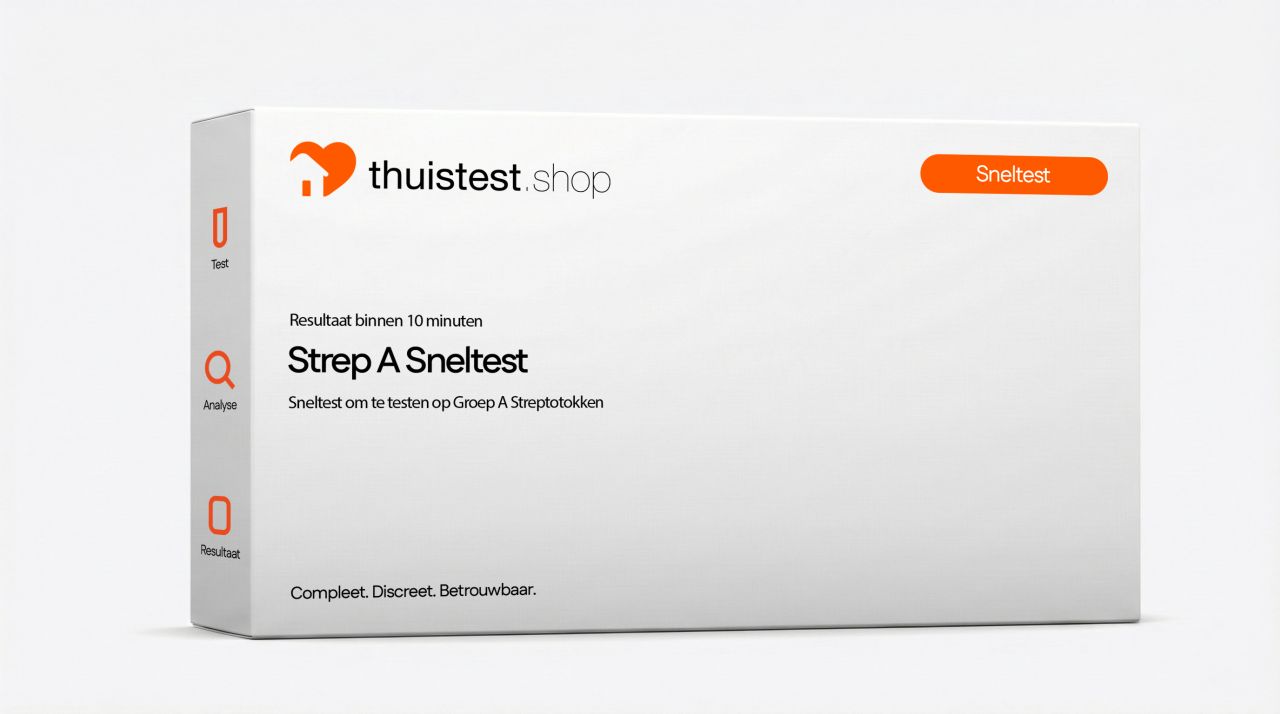
Strep A Self-test
€ 18,17
PROFESSIONAL
Out of stock, available for pre-order
1
Strep A Self-test
Product Details
TEST IS ONLY FOR PROFESSIONAL USE - Available mid-August 2026
The Strep A Self-Test is a rapid home test that helps determine whether a sore throat is likely caused by Group A Streptococcus. This is the bacterium that can cause a true bacterial throat infection in some people. Using a throat swab, you can check at home whether Strep A antigens are present. You usually receive a result within approximately 10 minutes.
This test is especially useful if someone has a severe sore throat and wants to know whether bacteria may be involved. Many sore throats are caused by a virus. In that case, antibiotics will not help. With Strep A, treatment may be necessary, especially in severe cases or when there is a risk of complications. A quick check can therefore provide reassurance and help determine the next step.
What is Strep A?
Strep A is the short name for Group A Streptococcus. This bacterium can cause a throat infection, also known as “strep throat.” It often starts suddenly. The sore throat can be severe. Swallowing may be painful and someone may develop a fever. The glands in the neck may also become swollen.
Important: Strep A is contagious. It mainly spreads through coughing, sneezing, and close contact. That is why getting quick clarity is helpful, especially within families, at school, or at work.
About the Strep A home test
The Strep A Self-Test is a qualitative antigen test. This means the test shows whether Strep A is likely present, but not how much. You take a swab yourself from the back of the throat, process it with the supplied liquids, and then read the result on the test cassette.
The test is intended as a practical first indication. With a positive result, medical follow-up is often advisable. With a negative result, a virus or another cause is more likely. However, symptoms remain the most important factor. If someone feels seriously ill or symptoms worsen, contacting a doctor is recommended.
Who exactly is this home test for?
The Strep A Self-Test is intended for people with a sore throat who want to know whether Strep A (Group A Streptococcus) is likely the cause. The test is especially suitable for someone with sudden, severe sore throat symptoms and possibly fever, particularly when there is little coughing or runny nose. The test is also useful for parents who want quick clarity when a child has severe sore throat symptoms, provided the child is old enough according to the instructions. This home test is practical for people who cannot immediately get a medical appointment but still want to act appropriately. For people with vulnerable health conditions or recurring severe throat complaints, medical assessment remains important.
What if you already have symptoms?
If someone has clear symptoms, it helps to get direction quickly. The Strep A Self-Test can be a first step. With a positive result, contacting a doctor is advisable because treatment may sometimes be necessary. Especially in cases of high fever, severe pain, or rapid worsening. With a negative result, a virus is often more likely. In that case, rest, sufficient fluids, and pain relief according to the package leaflet are usually more appropriate. If symptoms remain severe or persist longer, medical evaluation is still recommended. Contact a doctor immediately in case of shortness of breath, drooling, difficulty swallowing, drowsiness, or dehydration. Extra caution is also advised for young children and vulnerable adults.
General note
This test is not suitable for children under 2 years old. A home test is also not a replacement for medical assessment in severe cases. Contact a doctor immediately in case of shortness of breath, drooling, swallowing problems that worsen quickly, drowsiness, dehydration, or if someone is barely able to drink.
Use the test calmly and follow the steps exactly. An incorrect swab or incorrect reading may lead to uncertainty. Repeat the test with a new kit if the result is invalid.
Frequently Asked Questions about the Strep A Self-Test
How reliable is a Strep A Self-Test?
A Strep A rapid test is usually fairly specific. This means that a positive result is often correct. Sensitivity does vary, however. On average, rapid tests miss some real Strep A cases. Therefore, a negative result can still miss Strep A, especially when symptoms are strong. It helps to combine the result with the symptoms. If someone is truly ill with fever and painful swallowing, contact with a doctor may still be necessary. For mild cold symptoms, a negative result is often reassuring.
When is the best time to test for a sore throat?
Testing is most useful when symptoms are clear. For example, sore throat with fever, painful swallowing, and feeling ill. Testing is less useful with only mild throat irritation. Proper sample collection is also important. A good swab along the tonsils makes the result more reliable. If symptoms started suddenly and fit with Strep A, a throat infection test can help provide direction at that moment. If symptoms worsen quickly or there are warning signs such as shortness of breath, direct medical contact is wiser than testing first.
Should someone take antibiotics after a positive result?
Not automatically. A positive Strep A Self-Test means that Strep A is likely present. Whether antibiotics are necessary depends on how ill someone is, how long symptoms have lasted, and whether there are additional risks. That is why medical advice is important after a positive result. A doctor can also determine whether scarlet fever or another complication may be present. In some people, antibiotics help shorten symptoms and limit spread. In others, good symptom relief is sufficient. Trying to obtain antibiotics yourself is not a good idea. It is better to choose a safe plan with professional guidance.
How can someone tell whether it is more likely a virus than Strep A?
A virus more often causes cold-like symptoms. Think of coughing, a runny nose, and hoarseness. Red eyes or mouth ulcers are also more common with a virus. Strep A, on the other hand, is more often associated with sudden severe sore throat, fever, and tender glands, without clear cold symptoms. Still, it is not always possible to tell by symptoms alone. That is why a home sore throat test can sometimes be useful. The result provides an extra indication. If symptoms persist or become severe, it is wise to seek medical advice, even if it “probably seems viral.”
When is it wise not to wait and seek immediate help?
Immediate help is advisable in case of shortness of breath, drooling, inability to swallow, drowsiness, or rapid deterioration. These are not normal signs of a simple throat infection. For children, it is also important to call a doctor if the child refuses to drink or becomes increasingly ill. A scarlet-fever-like rash with high fever is also a good reason to contact a doctor. The test is intended for situations of uncertainty, not emergencies. If there is any doubt about severity, calling a doctor is always the safest step.
When does Strep A fit with a throat infection?
Strep A is especially associated with a sore throat that starts quickly and is severe. Swallowing is often painful. Fever is common. The glands in the neck may become swollen and tender. In some people, the throat appears bright red. The tonsils may also be swollen.
Still, it remains difficult to judge based on symptoms alone. Viral throat infections can also be severe. That is why testing is useful when in doubt. The Strep A Self-Test helps you choose: wait with good self-care or proceed with medical evaluation. This can help avoid unnecessary antibiotic use, while also reducing the risk of waiting too long.
Symptoms that often fit with Strep A
There are several signs that fit Strep A more often than a common cold. Think of fever without a clear runny nose. Also severe sore throat without coughing. Headache and abdominal pain can sometimes occur in children. Some people also experience nausea.
With Strep A, someone often feels “truly ill.” However, this is not always the case. That is why the test is mainly a tool to estimate the likelihood. It is not a scorecard for how bad someone feels.
Symptoms that fit less well with Strep A
With a virus, you more often see a runny nose, cough, and hoarseness. Red, irritated eyes and sneezing are also more common with a cold virus. In those cases, the chance of Strep A is usually lower. However, there can still be overlap, especially in the beginning.
If someone mainly has a tickly cough, blocked nose, and mild sore throat, a viral cause is more likely. In that situation, testing can still be done, but the benefit is sometimes lower. When in doubt, it helps to look at the complete picture: fever, throat symptoms, swollen glands, and general malaise.
Preparation for a reliable result
For a good sample collection, it is important to stay calm. Preferably do not eat or drink shortly before the test. Read the instructions completely and prepare everything in advance. Use a timer. Also ensure good lighting when reading the result.
The throat swab is the most important step. You must use the swab along the tonsils at the back of the throat. This may trigger a gag reflex. That is normal. Try to hold the tongue down with a spatula and touch the cheeks or tongue as little as possible. This makes the sample “cleaner” and often more reliable.
Step by step: how to use the test
First, take the swab sample from the throat. Then mix the swab with the liquid in the tube. Stir and squeeze the swab according to the instructions. Next, drip the mixture onto the test cassette. Then wait for the indicated time. Usually this is 5 to 10 minutes.
Do not read the result too early. Also do not read it too late. The timing window is important. Dispose of the materials properly afterward and wash your hands thoroughly.
Reading the result: positive, negative, or invalid
The test almost always has a control line. This control line must be visible. If it is not, the test is invalid. You will need to repeat the test with a new kit.
With a positive result, you usually see two lines. This means Strep A is likely present in the throat sample. With a negative result, you only see the control line. This means Strep A is less likely. Keep in mind that a very faint test line often also counts. Follow the explanation in the instructions.
Positive result: what now?
A positive result is a clear reason to contact a doctor. Especially in cases of high fever, severe sore throat, or rapid deterioration. Strep A can be treated. Treatment may shorten symptoms and help prevent complications.
Until you receive proper advice, it is wise to keep some distance and maintain good hygiene. Wash hands frequently. Do not share glasses or cutlery. Avoid close contact, especially with vulnerable individuals such as babies, elderly people, and those with weakened immune systems.
Negative result: what now?
A negative result means that Strep A is less likely. In many cases, a virus is more likely. In that case, self-care is most important: drink enough fluids, rest, and use pain relief according to the package leaflet if needed. A sore throat can still feel severe, even with a virus.
If symptoms last longer than expected or someone becomes more ill, contact a doctor. A negative test does not rule out every bacterial cause. Other problems may also be involved. If in doubt, medical advice is always recommended.
Additional information: transmission, retesting, and recovery tips
Strep A can spread within families and groups. That is why it is smart to stay alert if several people suddenly develop sore throat and fever. Testing can then help guide quicker action.
Retesting may be useful if the first test was invalid, or if you tested very early in the illness and symptoms increase afterward. Do not continue testing endlessly without a plan. With persistent symptoms, seeing a doctor is often the quickest route.
For recovery, it helps not to irritate the throat further. Drink lukewarm fluids, rest, and ventilate rooms well. Listen to your body. If swallowing becomes almost impossible or shortness of breath develops, do not wait.
Display prices in:EUR